


What every parent and grandparent needs to know about Trump accounts
What are Trump Accounts?
Trump Accounts, referred to as 530A accounts in the tax code, are a new type of account available to U.S. citizens age 18 or younger with a valid Social Security number. The deadline to enroll in a Trump account is the year before the child turns 18. They are governed by IRA rules once the child turns 18, but before then, there are notable differences. The biggest difference is that the child does not need employment income to contribute.
How much can be contributed?
A total of up to $5,000 may be deposited into the account every year until the year the child turns 18. This annual contribution limit indexes for inflation after 2027.
Who can contribute?
Perhaps the most talked-about contributor to Trump Accounts is the U.S. Treasury, which will contribute $1,000 in seed money to the Trump Accounts of children born between 2025 and 2028 after an account is opened. This government contribution does not count toward the $5,000 annual limit, and does not count as taxable income to the parents or their child when deposited. It will be taxed to the recipient when withdrawn in the future.
Parents, guardians, and grandparents are most likely to add to accounts, but funds can come from other sources. Contributions from family or friends are made with after-tax dollars and are not deductible to the contributor. The contributions are considered gifts and count toward the annual gift tax exclusion ($19,000 in 2026). With the possibility that multiple parties may wish to contribute, some coordination among contributors may be wise. If any contributor plans to give more than $19,000 to a child in a single year, see “How To Avoid Gift Taxes“. The numbers have changed since it was written in 2017 but the concepts described hold.

As an employee benefit, employers may contribute up to $2,500 per worker, not per child, to the account of an employee’s child. These employer contributions count toward the $5,000 annual limit. Similar to the $1,000 seed money, these employer contributions will not count as taxable income to the worker or their child when deposited but will be taxed to the recipient when withdrawn in the future. Recent proposed regulations from the U.S Department of the Treasury would allow employers with cafeteria plans to facilitate pre-tax contributions from employees if specific requirements are fulfilled.
Certain governmental entities and charities may also make qualified general contributions to Trump Accounts, but only if the contributions are made to a qualified class of account beneficiaries. For example, the founder of Dell computers pledged to put up to $250 into the accounts of 25 million children born between 2016 and 2024 who live in certain zip codes with lower median household incomes.
What investments are available for these funds?
Until the child reaches 18, the law mandates that all funds be invested in the State Street SPDR Portfolio S&P 500 ETF (SPYM), a low-cost S&P 500-tracking index fund. Soon, four other low-cost index funds will be available, three of which track somewhat broader swaths of the U.S. stock market than the S&P 500.
Requiring Trump Account contributions to be invested entirely in stocks maximizes the funds’ growth potential, but it also means the account balance will fluctuate with the market. At age 18, the account is treated as an IRA, and the child can invest as they choose.
What is the best “use case” for Trump accounts?
Once the child turns 18, Trump Accounts are subject to IRA rules, so their best use case is as a head start on accumulating money for retirement. The best results are likely achieved by leaving the money alone until retirement age. By starting retirement savings so early, the potential value at retirement can be significant.
How are withdrawals from Trump accounts taxed?
Other than a direct rollover of the entire account to a Trump Account with another brokerage , certain rollovers to an ABLE account in the year the child turns 17, or distribution upon death, withdrawals from Trump Accounts before age 18 are not allowed at all. Upon turning 18, withdrawals are taxed under the standard rules for IRAs. Previously untaxed amounts, such as seed money and account earnings, will be taxable as ordinary income when distributed. Distributions before age 59 ½ are also subject to an additional 10% penalty unless an exception applies.
Because individual contributions are made with after-tax dollars, they create “basis” in the accounts. When a distribution is made, a portion is considered a return of basis and is not taxed. For example, if contributions total $10,000 and the account is worth $40,000, 25% ($10,000 ÷ $40,000) of any distribution will be tax-free, while the remaining 75% will be taxable.
Before age 18, basis is tracked on Form 5498-TA. At 18, when the account becomes an IRA, the child will be responsible for tracking basis. As with other IRAs, this is done on Form 8606.
How does a Trump account compare to other account types?
For general use before retirement age such as purchasing a car or first home, an account not subject to IRA rules is likely a better choice. Because non-retirement goals come long before retirement and the tax treatment is different, funding other account types will be a higher priority for most families. Other account types can benefit from tax rates lower than the ordinary rates applied to IRA withdrawals and are not subject to a 10% penalty before age 59 ½.
Tommy Lucas, CFP®, EA shared his thoughts on the first home purchase in an August 10th Orlando Sentinel story on Trump accounts which was syndicated to Yahoo Finance. “‘With how expensive houses are these days, $10,000 is not going to get you near what you need to put down,’ Lucas said, adding that if his clients want to help children save for a house he’d suggest other lower-tax options that allow for bigger withdrawals.” (Tommy uses the $10,000 figure because one of the exceptions to the 10% penalty for pre 59 1/2 distributions from an IRA is up to $10,000 toward the purchase of a home for first-time home buyers.)
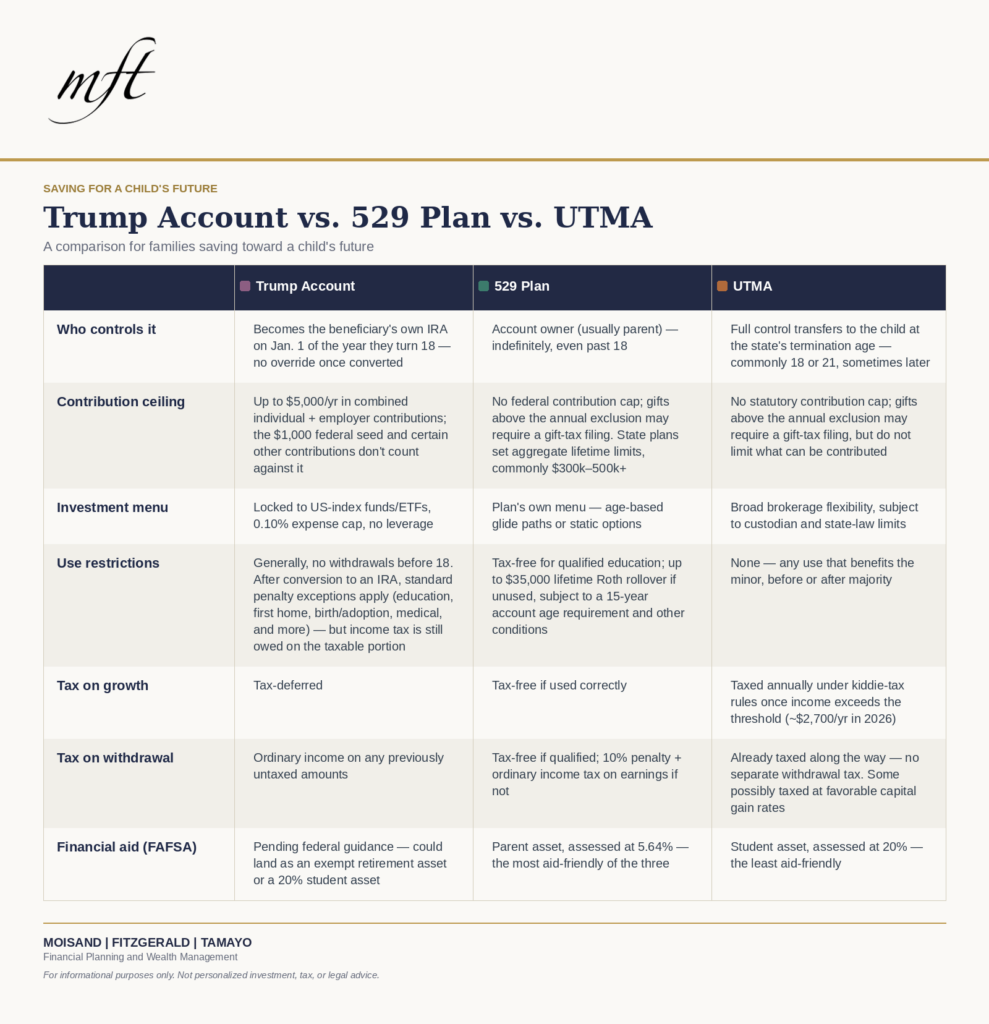
For the specific goal of covering educational expenses, a 529 savings plan will typically be superior.
For the specific goal of covering educational expenses, a 529 savings plan will typically be superior. Unlike a Trump Account, withdrawals from a 529 plan are tax-free when used for qualified education expenses. Parents can remain in control at age 18, contributions can exceed $5,000 annually, and some states offer tax incentives for 529 contributions.
Working minors should likely prioritize contributions to a Roth IRA before making a Trump Account contribution. Roth IRAs allow higher contributions—up to $7,500 in 2026, indexed in future years. Roth contributions can be withdrawn tax-free at any time before retirement, if needed. Earnings can be withdrawn tax-free after age 59 ½.
With a Trump Account, withdrawals are generally prohibited before age 18 and taxable when withdrawn, regardless of age. Taxable distributions before age 59 ½ from either a Trump Account or Roth IRA are generally subject to a 10% penalty in addition to the regular taxes due.
Trump Account contributions have no bearing on a child’s ability to contribute to a Roth IRA, so higher-income households could contribute to both types of accounts on behalf of a working child.
After age 18, when the Trump Account is subject to IRA rules, there may be an opportunity to convert the account to a Roth IRA. By converting to a Roth IRA, taxes are paid with no 10% penalty for being under age 59 ½ if the converted amount is left alone for five years. In return, future taxation on earnings is eliminated after age 59 ½.
Young adults often find themselves in the lowest tax brackets they will face in their lifetimes, giving conversions a chance to be very valuable. Nonetheless, converting is not a no-brainer, as the item below about overlooked aspects of Trump Accounts describes.
Can these accounts make a child rich?
Yes, if the account is left to grow until retirement age. Because the accounts are funded earlier than most people fund IRAs, 401(k)s, and other retirement accounts, the additional years of compounding can grow funds to significant amounts. For instance, a child born in 2026 who receives only the $1,000 seed money, never adds a dime to the account, and compounds the fund at 8% would have $148,780 at age 65.

If $5,000 contributions are made in each of a 2026 newborn’s first 18 years and the funds are left alone to compound at 8%, the accumulation at age 65 is $7,529,479. Any savings the child does during their adult working years would add to that total.
Older children can also benefit from getting some funds into an account before age 18. For instance, a 17-year-old who makes only one contribution of $5,000 but leaves it alone to compound at 8% would have more than $200,000 at age 65 from that one contribution.
What aspects of Trump accounts are not getting enough attention?
Two items worth considering are the so-called “kiddie tax” and the impact on financial aid.
Most students do not have much income while in school, so it is easy to assume they might not pay much in taxes if they tapped their Trump Account or converted it to a Roth IRA early in adulthood. However, that assumption could be very wrong.
The kiddie tax applies the parents’ tax rate to “unearned income” received by a child over a threshold ($2,700 in 2026). Unearned income includes taxable interest, dividends, capital gains, and distributions from retirement plans. Generally, the kiddie tax applies only to children under 18, but it can apply to students and others dependent on their parents between ages 18 and 24.
The balance of a child’s IRA is considered an exempt retirement asset and does not affect financial aid. However, no definitive guidance has been issued stating that a Trump account of someone under 18 or the IRA that is created when one reaches 18 will enjoy the same treatment.
Still, as it stands today, eligibility for need-based grants and scholarships uses taxable income to calculate a student’s Student Aid Index (SAI) on the Free Application for Federal Student Aid (FAFSA). Therefore, taxable amounts withdrawn from one of these accounts is expected to create a higher SAI that could dramatically reduce the amount of aid available two years after the distribution. (FAFSA uses tax returns from two years prior to determine current year aid.)
How do you open one?
Parents or guardians can open accounts by filing IRS Form 4547 with their tax return or using the app available on TrumpAccounts.gov. An eligible child in foster care can get an account through the child welfare agency of a state, territorial, or tribal government that is the legal guardian.
After the IRS approves Form 4547, the account opener must “activate” the account on the website, www.trumpaccount.com. This site is administered by a brokerage firm called Robinhood. Once the account is open, contributions can be made and the funds invested.
The selection of Robinhood for these accounts was met with some controversy due to the firm’s emphasis on trading securities rather than investing. Some critics even call Robinhood a glorified gambling site. Concerns about this are mitigated somewhat because the only transaction allowed before age 18 is moving from one index fund to another substantially similar index fund. All participants can do is hold an index fund, eliminating the temptation to time the market. Starting sometime in 2027, the account should be transferable to a different custodian.
Once filed, an account can be opened and activated through participating custodians using the Trump Account app. Families who registered prior to July 2026 through TrumpAccounts.gov may need to complete an additional identity verification process.
Beware of scams
Families should exercise caution whenever websites or apps require financial and personal data. As with anything new or interesting, scammers are prevalent. Several websites have similar names but are not affiliated with the authorized Trump Account platforms.
According to the Treasury Department: “If you receive a call or text about a Trump Account, do not respond; it is likely a scam.” For now, all official communication about your account will come via email from no-reply@trumpaccounts.treasury.gov.
Treasury further recommends that parents always access their child’s Trump Account through the Trump Accounts app or by typing TrumpAccounts.gov directly into their browser.
Are there any more caveats to consider with Trump accounts?
Two come to mind quickly: control and tax code changes. In and of themselves, neither is a reason to avoid a Trump account.

At 18, the child gets full authority over the account. Remember the newborn we mentioned earlier that had $5,000 contributed to the account for each of their first 18 years? Well, at an 8% growth rate, that account would be worth a bit over $200,000 at age 18.
The existence of the account may provide opportunities to educate and coach a child about saving and investing. Every parent or grandparent would like to think their descendant will make prudent choices with these funds at 18. However, there is a possibility that the child will stop by the auto dealership on the way to campus, or use the funds for something other than a great start toward a secure retirement.
Today, we often cite 65 as a “normal” retirement age. A child born in 2026 turns 65 in 2091. We do not know exactly what the changes will be, but it is a good bet the tax code will be different by then. That is not a reason to avoid Trump Accounts, but it could cause the math not to work out as well as planned.
Bottom line: For families with enough means to make contributions and a desire to give their children or grandchildren a financial head start on retirement specifically, Trump accounts are worth considering.
Moisand Fitzgerald Tamayo named to 2026 list of the top Registered Investment Advisory firms in the U.S. by Financial Advisor magazine

“Moisand Fitzgerald Tamayo, LLC was named to Financial Advisor magazine’s 2026 list of the top Registered Investment Advisory firms in the U.S. The list is based on assets under management. Other than the year we somehow missed the deadline to be considered, we have appeared on this list every year since 2006.”